2026 Top TCU Equipment Types for Global Buyers
Global buyers are entering 2026 with stricter expectations for process stability, energy use, and equipment traceability. Tcu Equipment now supports many demanding applications, including plastics processing, food production, laboratories, battery manufacturing, and chemical plants. Each sector requires a different balance of temperature range, cooling capacity, flow control, and automation.
This guide examines the main TCU types available to international purchasers. It covers air-cooled and water-cooled units, electric heating systems, oil and water temperature controllers, modular systems, and high-precision laboratory models. Buyers will find practical details, such as stainless-steel construction, pump performance, heater response, controller interfaces, and operating conditions. Small details matter. A poorly matched pump can create unstable flow, while an undersized cooler may struggle during summer operation.
Reliable purchasing requires more than comparing catalog prices. Engineers should review application data, installation space, voltage requirements, local service coverage, spare-part access, and recognized safety certifications. Supplier testing records and documented performance claims deserve careful attention. Standards and certification requirements also vary between markets, so professional verification remains necessary.
No single model wins every plant. That assumption needs testing. Real operating data should guide the final choice, not attractive specifications alone. This overview aims to help distributors, plant managers, and technical buyers compare equipment with greater confidence. It also acknowledges an uncomfortable truth: published efficiency figures may not reflect actual performance under dust, voltage fluctuation, poor water quality, or changing production loads. Careful evaluation remains the strongest protection against an expensive mismatch.
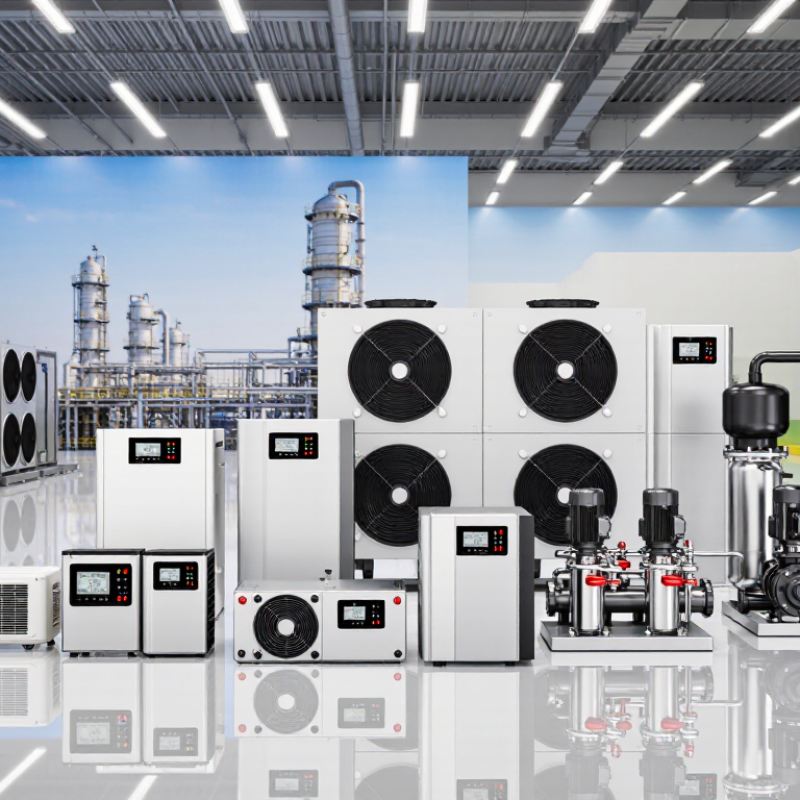
TCU Basics: Functions, Components, and Operating Principles
A temperature control unit (TCU) regulates process temperature through a controlled fluid circuit. It heats, cools, or maintains fluid near a selected setpoint. Common applications include molds, rollers, reactors, and laboratory vessels. Precision starts here. A stable temperature can improve product consistency and reduce thermal stress.
Most TCUs contain a heater, circulation pump, cooling valve, heat exchanger, reservoir, filter, and temperature sensors. The controller compares the measured temperature with the target value. It then adjusts heating or cooling output. The pump moves fluid through hoses and the connected equipment. Water-based units suit moderate temperatures and fast heat transfer. Oil-based units support higher operating ranges, but they require careful fluid selection and maintenance.
In real installations, performance depends on flow rate, hose length, insulation, ambient temperature, and load changes. Small errors matter. A sensor placed too far from the process may create misleading readings. Buyers should check temperature range, pressure rating, heating capacity, cooling capacity, control accuracy, fluid compatibility, and electrical requirements. Local voltage and safety standards also need verification. Do not judge a TCU by capacity alone. A powerful heater cannot fix poor circulation. In practice, no TCU behaves perfectly during sudden load changes, and this point deserves honest testing. Logging temperature and pressure during commissioning often reveals problems that a product sheet misses.
Water-Temperature Control Units for Global Industrial Applications
2026 Top TCU Equipment Types for Global Buyers
For global buyers, TCU selection starts with the process, not the catalog. Injection molding, chemical blending, food processing, and battery testing require different thermal behavior. Common equipment types include direct-contact water units, indirect heat exchangers, air-cooled systems, and water-cooled systems. Oil-heating TCUs suit higher setpoints, while cascade units support demanding temperature ranges. Pressure matters too.
The IEA’s Energy Efficiency 2023 report states that industry consumes about 37% of global final energy. This makes thermal losses a serious purchasing concern. The U.S. Department of Energy’s pumping-system guidance notes that pumping can consume 25% to 50% of industrial motor energy in some facilities. Choose variable-flow control when the load changes. Do not oversize.
In plant trials, stable outlet temperature often matters more than rapid pull-down. Specify flow rate, heat-transfer fluid, allowable pressure, ramp time, sensor accuracy, and maintenance access. Water-cooled designs may reduce local noise, but they need reliable water quality and discharge planning. Air-cooled units simplify installation, yet hot rooms can reduce capacity. These trade-offs are easy to miss. Reports guide decisions, not replace site testing. That is the uncomfortable part.
2026 Top TCU Equipment Types for Global Buyers
The chart compares representative operating temperature ranges for water-temperature control units used in major industrial applications. Actual setpoints depend on the process, material, tooling, heat load, and local safety requirements.
Oil-Temperature Control Units for High-Precision Manufacturing
2026 Top TCU Equipment Types for Global Buyers
Oil-Temperature Control Units for High-Precision Manufacturing
Oil-temperature control units help manufacturers protect process stability during molding, coating, laminating, and precision machining. They circulate thermal oil through jackets, platens, or narrow machine channels. Stable flow matters as much as temperature accuracy. A weak pump can create hot spots, even when the display shows perfect readings.
In factory commissioning, engineers should check heating rate, cooling response, sensor position, and return-line temperature. A practical unit may offer closed-loop control, insulated piping, a stainless-steel reservoir, and alarms for low level or excessive pressure. For demanding production, buyers often compare control stability within ±0.1°C, but actual results depend on load changes, oil condition, and installation quality.
Details matter.
Global buyers should verify voltage, frequency, communication protocols, oil compatibility, spare-part access, and local service capability. A compact unit may save floor space but restrict maintenance access. Larger pumps may improve circulation but increase energy use and noise. These trade-offs are easy to overlook.
A specification sheet is not enough. Ask for factory test records, calibration methods, pressure-test evidence, and operating data under changing loads. Thermal oil can degrade through oxidation or overheating, so filtration and scheduled inspection deserve attention. I have seen temperature drift blamed on the controller when blocked filters caused the real problem. Some uncertainty remains, especially when suppliers test equipment without the buyer’s actual tooling, oil volume, or production cycle.
Portable, Modular, and Centralized TCU System Configurations
2026 Top TCU Equipment Types for Global Buyers
Portable, Modular, and Centralized TCU System Configurations
Portable TCUs suit laboratories, pilot lines, and facilities with changing production needs. Operators can move these compact systems beside a reactor or processing vessel. Lockable casters, quick-connect fittings, and clear control panels improve daily handling. Buyers should check cooling capacity, heating range, pump flow, and electrical compatibility before ordering. A small footprint helps, but limited reservoir volume may restrict continuous operation.
Modular TCU systems offer a practical middle ground for growing factories. Individual heating, cooling, pumping, and control modules can be configured around process demands. This design supports phased investment and easier maintenance. For example, technicians can replace a circulation module without disturbing the entire production line. However, modular layouts require careful interface planning. Inconsistent pipe sizes or control signals can create avoidable delays.
Centralized TCU systems serve facilities with several production lines and stable thermal requirements. One central unit can distribute conditioned fluid through insulated piping to multiple users. This arrangement saves floor space near each machine and simplifies plant-wide monitoring. It also demands accurate hydraulic calculations, proper balancing, and dependable backup planning. A single failure may affect several processes. That risk is sometimes underestimated.
Global buyers should review local voltage standards, pressure regulations, fluid compatibility, documentation, and service availability. Ask for performance data under realistic ambient conditions, not ideal laboratory figures. Noise levels and access for cleaning also matter. No configuration is perfect. The right choice depends on process variation, expansion plans, operator experience, and the cost of downtime.
How to Select TCU Equipment for International Purchasing Needs
How to Select TCU Equipment for International Purchasing Needs
Selecting TCU equipment requires more than comparing heating capacity and purchase price. Define the process fluid, temperature range, flow rate, cooling method, and installation environment. Water-based units suit moderate temperatures and fast heat transfer. Oil-based units support higher temperatures but need stronger seals and careful fluid compatibility checks. Air-cooled systems may simplify installation where cooling water is limited.
Energy performance deserves close attention. The IEA’s Energy Efficiency 2023 report states that industry used about 37% of global final energy in 2022. A small efficiency difference can become expensive during continuous operation. Ask suppliers for measured power consumption, control accuracy, recovery time, and standby performance. Request test conditions, not only attractive catalog figures.
International purchasing adds practical risks. UNCTAD’s Review of Maritime Transport 2024 notes that over 80% of global trade by volume moves by sea. Select equipment with export-safe packaging, replaceable components, multilingual manuals, and clear customs documentation. Verify voltage and frequency, such as 400 V/50 Hz versus 460 V/60 Hz. Check local conformity requirements, emergency-stop design, and electrical standards before ordering.
A tidy specification sheet can still mislead. Site water quality, ambient heat, and operator habits often change performance. Include spare sensors, filters, seals, and a remote troubleshooting plan. Do not assume the cheapest TCU has the lowest ownership cost. That assumption fails surprisingly often.